
How to Start a Business - Texas Edition
Starting a business in Texas begins with building the right foundation. Whether you're starting a small business, forming an LLC, or turning an idea into a new company, understanding the basic Texas business requirements can help you make better decisions.
Before getting started, consider these key areas:
Create a business plan — Define your
customers, products or services, startup costs, pricing and revenue model.
Choose a Texas business structure — Explore sole proprietorships, partnerships, LLCs and corporations.
Choose your business name — Research Texas naming requirements and determine whether you may need an assumed name (DBA).
Research registration, taxes and permits — Identify the Texas business registrations, tax responsibilities, licenses and permits that may apply.
Plan your startup funding — Estimate startup and operating costs and determine how you'll finance the business.
Texas Business Advisor Resources
Texas Governor — Start a Business in Texas — Official guidance covering business planning, registration, taxes, permits, employees and financing.
Texas Secretary of State — Selecting a Business Structure — Information about Texas business structures and important considerations when choosing one.
Texas Secretary of State — Formation FAQs — Answers to common questions about Texas business formation, entity names and assumed names.
Start with the right information.
Build the right foundation.
Then build a business designed to grow.

Step 2
Build a Business That Works for You
Once your business is formed, the next step is building the systems that keep it running. Strong businesses depend on consistent operations, accurate records, tax compliance, employee responsibilities, and processes that can support future growth.
Focus on these key areas:
1. Stay current with Texas taxes — Understand the state tax and reporting obligations that may apply to your business. The Texas Comptroller is the primary source for Texas franchise tax and other state tax information.
2. Set up your employer responsibilities — If you hire employees, understand unemployment tax registration, wage reporting, new-hire reporting, and other employer requirements.
3. Keep accurate business records — Build a routine for financial records, payroll, taxes, contracts, customer information, and important business documents.
4. Create repeatable systems — Document how work gets done so the business does not depend entirely on one person.
5. Build for the future — Strong systems can make a company easier to manage, grow, finance, and eventually transfer to another owner.
#4 Pays off the most when you want a 30 Day Vacation!!
Official Texas Business Resources
Texas Comptroller — Franchise Tax — Official information about Texas franchise tax, filing, and reporting requirements.
Texas Workforce Commission — New Texas Employer Information — Guidance for Texas employers covering unemployment-tax liability, wage reporting, new-hire reporting, and workplace requirements.
Texas Workforce Commission — Unemployment Tax Basics
Information about unemployment-tax accounts, quarterly wage reports, and employer tax responsibilities.
Build systems today that make your business stronger tomorrow

Step 3

Turn Business Growth Into Business Value
Growing a Texas business is about more than increasing sales. Sustainable business growth comes from understanding your customers, strengthening sales and marketing, using capital wisely, improving operations, and making decisions that create long-term business value.
Five Steps to Grow Your Texas Business
1. Know Where You Want to Grow
Set clear goals for revenue, customers, locations, products, services, or market expansion. Growth should have a purpose and a plan.
2. Understand Your Customers & Market
Know who buys from you, why they choose you, what your competitors offer, and where new opportunities may exist.
3. Strengthen Sales & Marketing
Develop a marketing plan that identifies your target market, competitive advantage, sales strategy, and how you'll reach potential customers. The SBA provides guidance for developing marketing and sales strategies.
4. Find Resources & Funding
Expansion may require additional capital, training, professional guidance, or local resources. Texas provides a customized Small Business Resource Portal covering growth assistance, funding sources, licensing, permitting, and other resources.
Texas Governor — Small Business Resource Portal
The SBA also provides guidance for established businesses seeking additional funding and recommends preparing a business case, financial statements, and forecasts before approaching funding sources.
5. Grow With Long-Term Value in Mind
Growth should make your business stronger—not simply bigger. Consider whether your decisions improve profitability, systems, customer relationships, management, and the company's ability to operate without depending entirely on the owner.
Don't Just Grow Bigger. Grow Stronger.
Growth creates opportunities, but it also creates new decisions.
Business Advisor can help you look at where your business is today, where you want it to go, and what could make it stronger and more valuable along the way.
Step 4

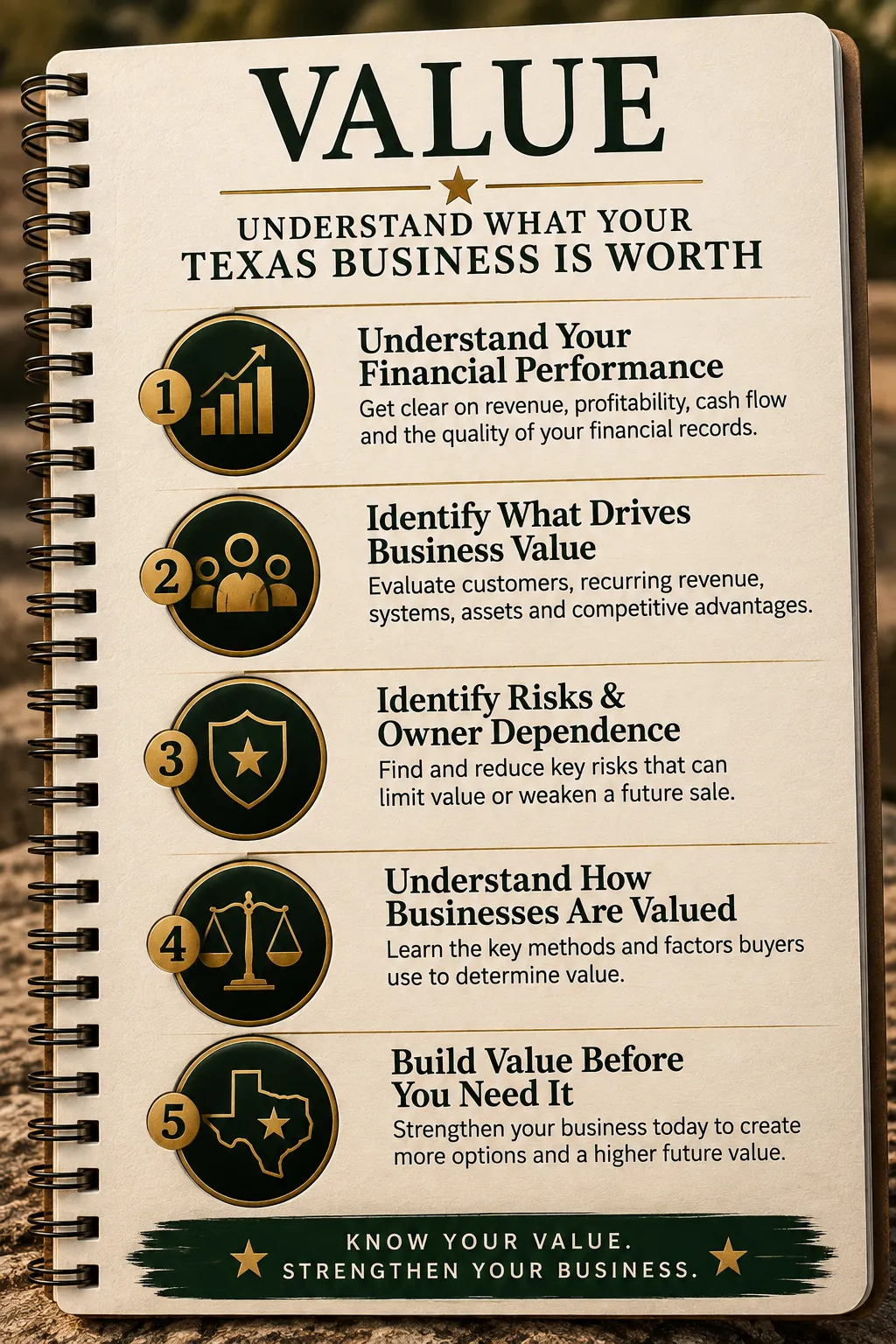
VALUE — Understand What Your Texas
Business Is Worth
Know Your Value. Strengthen Your Business. Prepare for What's Next.
Understanding the value of your Texas business isn't only important when you're ready to sell. Knowing what drives business value can help you make better decisions, improve profitability, reduce risk, and build a stronger company for the future.
Five Steps to Understanding Business Value
1. Understand Your Financial Performance
Buyers and advisors look closely at revenue, profitability, cash flow, expenses, and the quality of your financial records. Clean, organized financials make it easier to understand how the business is actually performing.
2. Identify What Drives Business Value
Strong customer relationships, recurring revenue, experienced employees, documented systems, reputation, assets, and competitive advantages can all contribute to the strength of a business.
3. Identify Risks & Owner Dependence
A business that depends heavily on its owner, one customer, a key employee, or undocumented knowledge may carry additional risk. Identifying these weaknesses gives you an opportunity to address them.
4. Understand How Businesses Are Valued
Business valuation can involve financial performance, assets, comparable transactions, industry conditions, risk, and future earning potential. An asking price and the value supported by the business are not always the same thing.
5. Build Value Before You Need It
You don't have to be ready to sell to start improving business value. Strengthening financials, systems, management, customer diversity, and operations today can create more options tomorrow.
Trusted Business Valuation Resources
SBA — Close or Sell Your Business — An overview of business valuation considerations and preparing a business for a sale.
IRS — Valuation of Assets — IRS guidance covering fair market value and approaches used when valuing different types of property.
Your Business May Be Worth More Than a Number
Understanding business value can reveal both strengths worth protecting and weaknesses worth improving. That's valuable information whether you're planning to grow, transition the company, bring in a partner, or eventually sell.
Business Advisor can help you look at your company from a business owner's and future buyer's perspective, identify the factors that may influence value, and determine where to focus next.
Know what you've built. Understand what drives its value. Make your next move with confidence.
Step 5

BUY — Buy a Texas Business With Confidence
Real Wealth Creation begins with business ownership.
Buying an existing business in Texas can offer a path to ownership with established customers, revenue, employees, equipment, and operating systems already in place. The challenge is determining whether the opportunity, financial performance, asking price, and future potential are right for you.
Michael J. Wheeler helps prospective buyers search for businesses for sale in Texas, evaluate opportunities, understand financial information, prepare for due diligence, consider financing options, and plan for a successful ownership transition.
Access to a Global Business-Buying Network
Through Transworld Business Advisors, buyers gain access to the resources of what Transworld describes as the world's largest business brokerage, with 1,000+ active brokers, 250+ offices worldwide, and more than 15,000 businesses sold.
Transworld also maintains a global network connecting business buyers and sellers across markets and industries. (TWorld)
That reach can help buyers look beyond a single listing and focus on finding a business that fits their goals, experience, investment range, location, and desired lifestyle.
Before You Buy, Understand What You're Buying
A business may look attractive on paper, but the numbers are only part of the story. Financial performance, customer concentration, employees, leases, equipment, owner dependence, operational systems, risks, and transition requirements can all affect whether an acquisition is the right fit.
You don't have to sort through those questions alone.
If you're considering buying a business in Texas, let's talk about what you're looking for and where to begin.
Sell your Business
SELL — Selling a Business in Texas
Selling a Texas business is more than a transaction. For many owners, it represents years of work, relationships, financial investment, and personal commitment. Preparing early can help you understand your business value, organize financial and operational information, and position the company for a successful transition.
Michael J. Wheeler is a Texas business broker with Transworld Business Advisors, where he works with business owners and buyers as part of his everyday professional practice. His work includes helping owners prepare businesses for sale, understand value, confidentially market opportunities, connect with qualified buyers, navigate due diligence, negotiate transactions, and work toward closing.
Through Business Texas Advisor, Michael brings that real-world brokerage experience to local Texas business owners who may be thinking about selling now—or simply want to understand what they should be doing today to prepare for the future.
Whether your exit is months away or several years down the road, understanding the process early can help you make better decisions.
Thinking about selling your Texas business? Let's have a conversation about where you are today and where you'd like to go.

What are the first steps to starting a business in Texas?
"Start with the end in mind" - Steven Covey
Start by developing your business idea and plan, choosing a business structure, selecting a business name, and identifying the registrations, taxes, permits or licenses that may apply.
The right foundation can make it easier to operate and grow your business
Business Texas Advisor can help you organize the process, identify the questions you should be asking, and connect you with reliable resources as you move forward.
Should I form an LLC when starting a business in Texas?
An LLC is a popular option, but it isn't automatically the right structure for every Texas business. Liability, taxes, ownership, management, future growth and transferability should all be considered.
Business Texas Advisor can help you think through your business goals and prepare the right questions to discuss with your attorney or tax professional before making the decision.
What licenses and permits do I need to start a business in Texas?
Requirements depend on what your business does and where it operates. State agencies, cities, counties and particular industries may have different requirements.
Business Texas Advisor can help you build a startup roadmap so important items such as registrations, taxes, permits, financing and operating requirements don't get overlooked.
Ready to turn your idea into a Texas business?
Contact Business Texas Advisor to discuss your next step.


